
Future bioengineering refers to the next generation of methods and technologies for designing and producing biological solutions that address global challenges, with a particular focus on preventing and eradicating microbial biofilms. At its core, future bioengineering involves strategically guiding innovations through every stage of the Bioengineering Development Phase: from initial discovery and characterization of biofilm mechanisms, through rigorous optimization, to scaling and commercialization. These structured phases are not just academic; they ensure that groundbreaking discoveries effectively move from the lab bench to real-world impact.
Understanding these phases is crucial for professionals tackling persistent biofilm threats in healthcare, veterinary medicine, pharmaceuticals, and diverse industrial contexts. The past decade has seen rapid growth in synthetic biology, smart biomaterials, and targeted antimicrobial platforms, all aimed at disrupting biofilm formation or accelerating removal. As biofilms continue to drive hospital-acquired infections, reduce drug efficacy, and compromise industrial processes, the demand for translational bioengineering solutions has never been greater.
This article explains each development phase in clear terms, connects them to emerging technologies, and showcases where innovation is already turning the tide against some of the toughest biofilm-related problems worldwide.
What the Bioengineering Development Phase Means
Core Concepts and Terminology
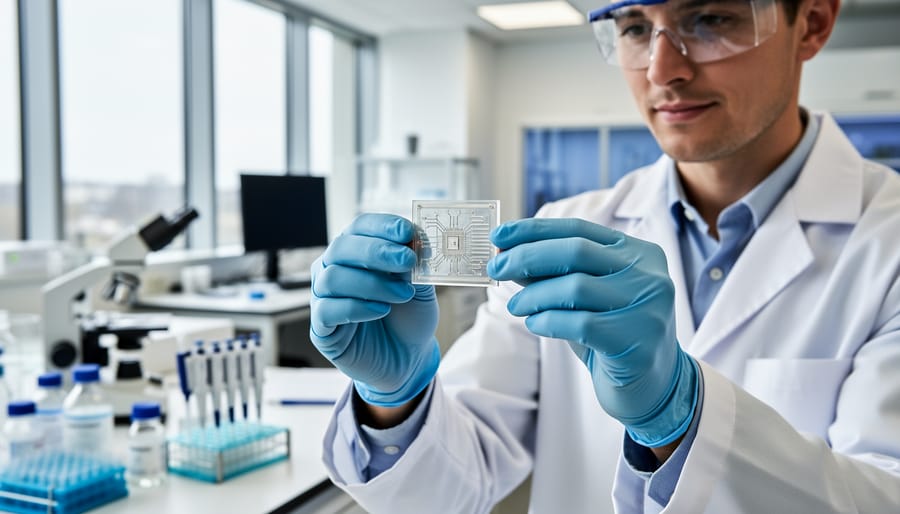
Understanding future bioengineering requires familiarity with several core concepts. Bioengineering itself refers to the application of engineering principles to biological systems, creating solutions that address medical, industrial, and environmental challenges. The Bioengineering Development Phase encompasses the structured pathway from initial discovery through validation to market-ready applications, a process increasingly taught in PhD bioengineering programs worldwide.
Key terminology includes synthetic biologywhich involves designing and constructing new biological components; genome editingparticularly CRISPR-based tools that enable precise DNA modifications; and biofilmthe complex microbial communities that form protective matrices resistant to conventional treatments. High-throughput screening accelerates discovery by testing thousands of compounds simultaneously, while computational modeling uses algorithms to predict biological behaviors before laboratory testing. These foundational concepts form the vocabulary necessary for grasping how next-generation bioengineering tackles previously intractable problems in healthcare and industry.
Why the Development Phase Is Critical
The development phase serves as the essential bridge between laboratory breakthroughs and solutions that save lives or transform industries. Without rigorous testing, iteration, and validation during this stage, even the most promising bioengineering concepts remain confined to academic papers rather than reaching patients or production facilities.
In the context of microbial biofilms, this phase becomes critically important because biofilms present unique challenges that don’t emerge in simplified lab conditions. A compound that disperses biofilms in a petri dish may fail entirely when confronted with the complex matrices found in hospital water systems, medical implants, or industrial pipelines. The development phase exposes these real-world complications early, allowing researchers to refine formulations, delivery mechanisms, and application protocols before costly manufacturing or clinical deployment.
This structured pathway also attracts investment and regulatory approval. Investors need proof that a technology works beyond proof-of-concept, while regulatory bodies require systematic evidence of safety and efficacy. PhD programs focusing on biotechnology play a vital role in fueling the development phase by training researchers who can navigate these technical and regulatory hurdles.
Furthermore, the development phase reveals scalability issues. An engineered enzyme that disrupts biofilms might be prohibitively expensive to produce at industrial volumes, prompting teams to redesign production strains or synthesis routes. Identifying such barriers early prevents wasted resources and accelerates the timeline from innovation to implementation.
How Bioengineering Works in the Future: From Bench to Application
Discovery and Innovation
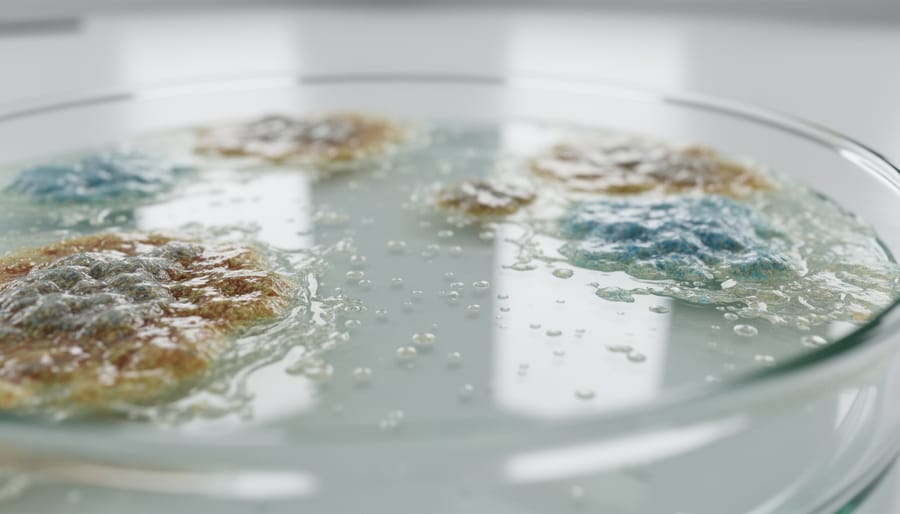
The discovery phase now unfolds in labs where computational models predict molecule behavior before synthesis begins, dramatically shortening the innovation pipeline from hypothesis to candidate. Algorithms screen millions of theoretical compounds overnight, identifying those most likely to disrupt biofilm adhesion or block quorum sensing, an approach where machine learning boosts hit rate by 40 percent compared to random screening. Automated laboratories equipped with liquid handlers and microplate readers test these leads in parallel, running thousands of assays that once took months to complete manually. Advanced biosensors embedded in real-time monitoring systems detect biofilm formation at femtogram concentrations, flagging subtle metabolic shifts invisible to conventional methods. This integration of digital prediction, robotic execution, and ultrasensitive detection accelerates the journey from concept to validated lead candidate, transforming discovery from isolated eureka moments into systematic, data-rich exploration.
Development and Validation
Once a bioengineering concept shows promise in early discovery, it enters a rigorous development and validation phase where theoretical designs face real-world testing. Engineers refine genetic circuits, optimize metabolic pathways, and prototype delivery systems, often iterating dozens of times to balance efficacy with safety. For anti-biofilm agents, this stage involves exposing engineered enzymes or CRISPR therapeutic applications to robust biofilm models that mimic hospital surfaces, implant environments, or industrial pipelines. Researchers measure bacterial kill rates, resistance development, and off-target effects using high-throughput assays and live imaging. Preclinical trials follow: candidates are tested in animal models to confirm that they disrupt biofilms without harming healthy tissue or triggering immune overreactions. This transition from research to validation is where most concepts fail, filtering out solutions that cannot scale or prove safe under clinical scrutiny. Only those passing stringent benchmarks, demonstrated biofilm clearance, reproducible manufacturing, and favorable toxicity profiles, advance toward regulatory review and eventual commercialization.
Commercialization and Scale-Up
Bringing a bioengineering innovation from laboratory proof-of-concept to commercial reality demands careful navigation of regulatory frameworks, manufacturing challenges, and market adoption. For anti-biofilm technologies and other biotechnological products, developers must first demonstrate safety and efficacy through rigorous preclinical and clinical trials that satisfy agencies such as the FDA, EMA, or equivalent national regulators. These pathways vary by product class, engineered enzymes may follow biologics routes, while diagnostic biosensors face different requirements, and early engagement with regulatory bodies can streamline approval timelines.
Manufacturing scale-up presents its own hurdles. Laboratory processes that work at milligram scale must be re-engineered for kilogram or ton production without losing product quality or activity. This transition often requires purpose-built fermentation facilities, continuous process monitoring, and strict quality control to ensure batch-to-batch consistency, especially for living therapeutics or complex protein formulations targeting biofilms.
What are the biggest regulatory challenges for bioengineering products?
Regulatory pathways differ by product type, and novel bioengineering approaches may lack clear precedent, requiring close dialogue with agencies to establish appropriate safety and efficacy standards.
How do companies scale up bioengineering production?
Scaling requires re-engineering lab processes for industrial bioreactors, implementing robust quality systems, and validating that the final product retains its intended bioactivity at commercial volumes.
What factors drive successful market adoption?
Adoption hinges on demonstrating clear clinical or operational benefits, competitive pricing, ease of integration into existing workflows, and building trust with end users through transparent data and post-market support.
Real-world deployment extends beyond regulatory approval and manufacturing capacity. Successful commercialization requires market education, distribution networks, post-launch surveillance, and responsiveness to field performance data. For biofilm-targeted solutions in hospitals or industrial settings, this means training end users, establishing supply chains, and demonstrating measurable improvements in infection rates or system efficiency that justify adoption costs.
Major Types and Components of Future Bioengineering
Biofilm-Focused Approaches
Biofilm-focused approaches in future bioengineering harness programmable biological systems to dismantle the protective matrices that make bacterial communities so resistant. Engineered bacteriophages carrying biofilm-degrading enzymes now penetrate polysaccharide shields and deliver lytic payloads directly to embedded cells, achieving log-scale reductions in species that ignore conventional antibiotics. Synthetic dispersal agents modulate quorum-sensing pathways, forcing coordinated detachment without triggering resistance genes. CRISPR-based antimicrobials selectively edit chromosomal DNA in target pathogens within established biofilms, causing lethal mutations that leave commensal flora intact. Electroactive biofilms paired with conductive polymers enable real-time disruption through mild electrical currents in medical implants and water systems. Enzyme cocktails combining DNase, proteases, and polysaccharide hydrolases are being optimized through machine learning to match the heterogeneous architectures of mixed-species communities in chronic wounds and industrial pipelines. These precision tools transform biofilm management from broad suppression to targeted eradication.
Emerging Platforms and Technologies
Several platforms are pushing bioengineering into entirely new territory. Modular gene circuits, synthetic networks of regulatory genes and promoters, allow researchers to program cells with logic gates, timers, and toggle switches, enabling precise control over when and where therapeutic molecules are produced. These circuits can be designed to detect biofilm-specific signals and activate dispersal agents only at infection sites.
Programmable probiotics represent another leap forward. By engineering beneficial bacteria with custom genetic circuits, scientists are creating living therapeutics that colonize the gut or mucosal surfaces, continuously secreting anti-biofilm compounds or immune-modulating proteins. Unlike static drugs, these microbial factories adapt to their environment and self-renew.
Real-time biofilm sensing technologies combine biosensors with digital readouts to monitor biofilm formation as it happens. Genetically encoded reporters emit fluorescent or electrical signals when they encounter biofilm markers like quorum-sensing molecules or extracellular DNA, enabling early intervention before infections become entrenched. These platforms converge engineering precision with biological adaptability, transforming how we prevent and treat biofilm-associated disease.
Integration with Digital Technologies
The convergence of bioengineering with digital technologies is fundamentally reshaping how researchers approach development phases. Machine learning algorithms now analyze vast genomic datasets to identify novel anti-biofilm targets in hours rather than months, accelerating the discovery stage. AI-driven predictive models simulate protein interactions and pathway modifications, enabling engineers to optimize biosynthetic routes before wet-lab validation begins.
Big data platforms integrate real-time experimental results from automated laboratories, creating feedback loops that refine designs iteratively. This digital-biological fusion extends through commercialization: cloud-based bioreactors monitored by Internet of Things sensors adjust production parameters dynamically, while neural networks predict scalability challenges before pilot manufacturing. What once required sequential experimentation now happens in parallel, compressing development timelines and reducing costs. These computational tools don’t replace traditional bioengineering, they amplify it, turning data into actionable insights that guide each phase from initial concept through regulatory approval and market deployment.
Applications and Impact: Where Future Bioengineering Is Used
Healthcare and Human Medicine
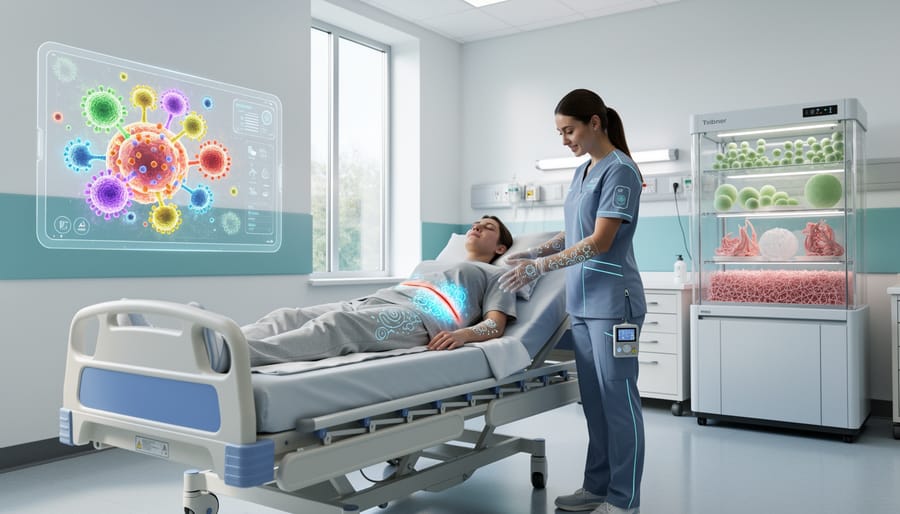
Future bioengineering promises profound changes in healthcare, especially in tackling persistent infections that resist conventional antibiotics. Engineered enzymes and dispersin-based formulations will degrade biofilms on medical devices such as catheters, ventilators, and joint implants, sharply reducing device-associated infections in intensive care units and surgical wards. Novel therapeutics derived from precision genome editing will target pathogen-specific vulnerabilities, delivering programmable bacteriophages or biofilm-disrupting peptides that eliminate infection while sparing beneficial microbiota.
Wound care stands to benefit from bioengineered dressings that release quorum-sensing inhibitors on demand, preventing chronic wound biofilms in diabetic ulcers and burn injuries. These smart materials respond to infection cues in real time, shortening healing cycles and lowering amputation risk. Hospital hygiene will shift from chemical disinfection alone to active surfaces coated with engineered probiotics or antimicrobial nanomaterials that continuously suppress microbial colonization. Deploying biofilm strategies against resistance in clinical settings addresses the growing threat of multidrug-resistant pathogens, improving patient outcomes and reducing healthcare costs across emergency departments, operating theatres, and long-term care facilities.
Veterinary and Animal Health
Bioengineered solutions are transforming how we tackle disease in livestock and companion animals. Scientists are developing programmable probiotics that colonize animal gut microbiomes to outcompete pathogenic biofilms, reducing reliance on antibiotics in food production. Engineered phages show promise against biofilm-forming bacteria in cattle mastitis and poultry infections, targeting pathogens without harming beneficial microbes. Vaccines built using synthetic biology platforms enable rapid response to emerging zoonotic threats, while biosensor-equipped feed additives detect early infection markers before clinical symptoms appear. For aquaculture, biofilm-dispersing enzymes prevent costly biofouling in tanks and hatcheries. These advances not only improve animal welfare but also address antimicrobial resistance, protecting public health by keeping resistant strains out of the food chain.
Industrial and Environmental Uses
Industrial sectors face persistent challenges from microbial biofilms that corrode pipelines, clog filtration systems, and contaminate products, issues that cost billions annually and compromise environmental safety. Future bioengineering offers targeted solutions through enzyme-based biofilm dispersants engineered to break down extracellular matrices without harsh chemicals, reducing environmental impact while maintaining infrastructure integrity.
In water treatment facilities, synthetic biofilms designed as living filters can capture pollutants and heavy metals, transforming remediation processes. These engineered microbial communities metabolize contaminants more efficiently than conventional methods, offering sustainable alternatives to chemical-intensive approaches.
Manufacturing environments benefit from programmable biosensors that detect early biofilm formation on equipment surfaces, triggering automated cleaning protocols before contamination spreads. In food processing, engineered antimicrobial peptides provide non-toxic surface coatings that prevent pathogenic biofilms without introducing chemical residues.
Oil and gas industries increasingly deploy bioengineered microbial consortia that prevent sulfate-reducing bacteria from forming corrosive biofilms in pipelines. These biological interventions extend equipment lifespan, reduce maintenance shutdowns, and lower the environmental footprint of extraction operations. The development phase for such industrial applications demands rigorous field testing under extreme conditions, ensuring solutions perform reliably across diverse operational environments.
Key Takeaways: The Future Shaped by Bioengineering Development Phases
The future of bioengineering hinges on rigorous, structured development phases that transform bold scientific ideas into real-world solutions. Each stage, from discovery through validation to commercialization, acts as a critical filter and accelerator, ensuring that innovations targeting microbial biofilms are not only scientifically sound but also scalable, safe, and clinically effective. Without this disciplined progression, even the most promising anti-biofilm technologies risk remaining trapped in the laboratory, unable to address urgent healthcare and industrial challenges.
The convergence of advanced tools, precision genome editing, AI-driven optimization, programmable biosystems, with these proven development frameworks positions bioengineering to tackle one of medicine’s most persistent adversaries: antimicrobial-resistant biofilms. As interdisciplinary teams refine each phase, integrating regulatory insight and manufacturing expertise early, the timeline from concept to patient or industrial deployment continues to shrink. This systematic approach does not stifle innovation; it channels it, transforming scientific breakthroughs into tangible benefits for global health and industry.